
Sunday, October 12, 2014

Saturday, October 11, 2014
Camping Trip

For Shaun's birthday, he wanted to go on a camping trip. Not just any camping trip though…a gathering of sorts, called a "knap-in". Knap as in flint-knapping. A paleolithic method in which to make stone tools for hunting to chopping down trees to everything in between. The knap-in was hosted by a non-profit group called Bridges to the Past. On their website they describe their mission as:

Before meeting Shaun years ago, I wasn't really aware of people still practicing ancient ancestral skills. There is a thriving sub-culture of people who do just this and in style. There are multiple gatherings throughout the year to learn, teach and observe how our ancestors crafted a life without the use of modern conveniences. They are a lot of fun to attend- fires and music at night, lots of interesting people, lots of shared food (usually grown or hunted by the attendees) and a chance to try out some ancient methods of crafting.
Set up at this gathering were targets to practice shooting an atlatl, an ancient spear-thrower, made by some of the folk attending. I got to try my hand at it after a brief lesson. It's not as easy as it looks...


Apparently, our ancestors from long ago used to take down mastodons with these arrows!!

Some of the flint-knapping in progress...


Some amazing final products.


The scene and how it's done…

I think this is called percussion knapping- using a stone (or antler) to flake off a piece of obsidian. Again and again and again. The flakes come off, quick mental measurements are made of where to strike and the end product is (usually) a completely functional tool, if the piece doesn't shatter from a miscalculation.


Lars was definitely not allowed in the knapping pit.
And Dad got some much needed free time to knap with friends and sharpen his tools…I'm not sure that's how I'd like to spend my birthday…but to every man his own.

Chilly morning but Lars got to try hot chocolate for the first time and work on his own projects. It was a great trip and we look forward to a similar type of gathering next June, called Between The Rivers. Be there or be square!


Friday, October 10, 2014
Sauerkraut Revisited

I have talked with countless people who are so eager to ferment their own food and yet they express anxiety of doing it wrong. There really is nothing to lose except a couple dollars worth of cabbage (or whatever other vegetable you choose to ferment), so try it! More than likely, you'll get it right the first time and get to enjoy many great meals rich in probiotics and a nutrient-dense vegetable added to dozens of meals.
In this post, I'm using cucumbers and cabbage. You'll need something to put your sauerkraut in. If you don't have a ceramic crock, find a food grade bucket. I'm using a five-gallon size, which was able to hold 5 medium sized cabbages and 6-8 cucumbers. Any size is fine. Start small if you're hesitant to invest in a large crock. Even try a mason jar!

You'll need something to cover the bucket or crock once it is full of cabbage. I went to a thrift store and found a plate that fit relatively well. Instead of bringing in the whole crock, you could stencil the diameter of the vessel on paper and just take that with you.

Another option is to make some homemade wood covers. We boiled these for a few hours on the wood stove just to make sure they didn't carry any contaminates. Both a ceramic plate or these work great!

Now it's time to get started!
I'm using a cabbage grater that I found at an antique store. This tool makes a really fine shred to the cabbage, which is adjustable. I also frequently use a basic kitchen shredder for a finer grate or just a good ol' knife for chunky kraut. It's fun to experiment with all different sizes. So don't feel like you have to go out and buy a grater specific to cabbage.

If the weather permits, I like to make kraut outside. It's a messy project with a little one in tow, so the picnic table is a good option for me. Before cutting the cabbage, save some of the outer layers of the cabbage. You'll see why in a few steps from now…

Start to grate or chop the cabbage until the vessel is 3/4 full. You can push down on the shreds to make room for more if need be.

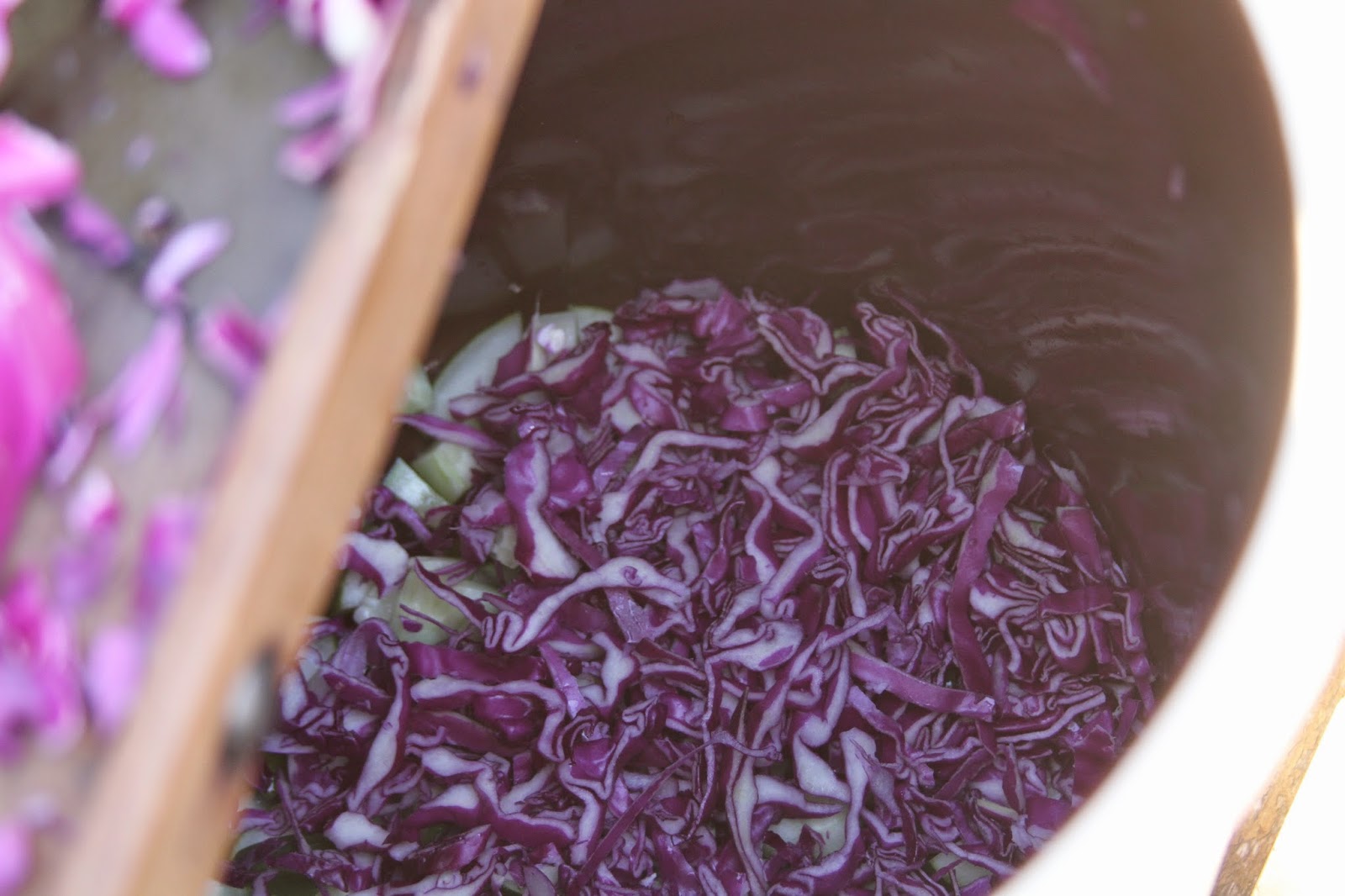
I didn't shred the cucumber but rather cut small square chunks. This is just a personal preference of crispiness once they are fermented. I'm just not into squishy sauerkraut…Gave Lars a butter knife and a slice of cucumber to "help out mama" with our afternoon project.


Once the crock is 3/4 full, fill it with water so that the cabbage is completely submerged. If you'll notice in the picture below, there is about 1/4 cup of fine sea salt thrown on top. I don't measure the salt but put enough in to taste. Not strong salt water, just mildly salty. With clean hands, I stick my hands in the batch and swish the salt around a bit for it to mix, then taste test.

Here's where the saved cabbage leaves come in. This is not an essential step but one I like to implement. The purpose is to help keep all of the cabbage bits submerged once the weight is on so that there will (hopefully) be none floating on top to get moldy.

Put the plate (or whatever weights you choose) over the batch.

The additional weight I use is a mason jar filled with water. I use a plastic lid because the anaerobic action from the fermentation process will erode a metal lid. You can use a metal lid if the jar is standing upright.
(Notice that I have some cabbage bits that still managed to float to the top. Just remove as many as possible with a slotted spoon.)
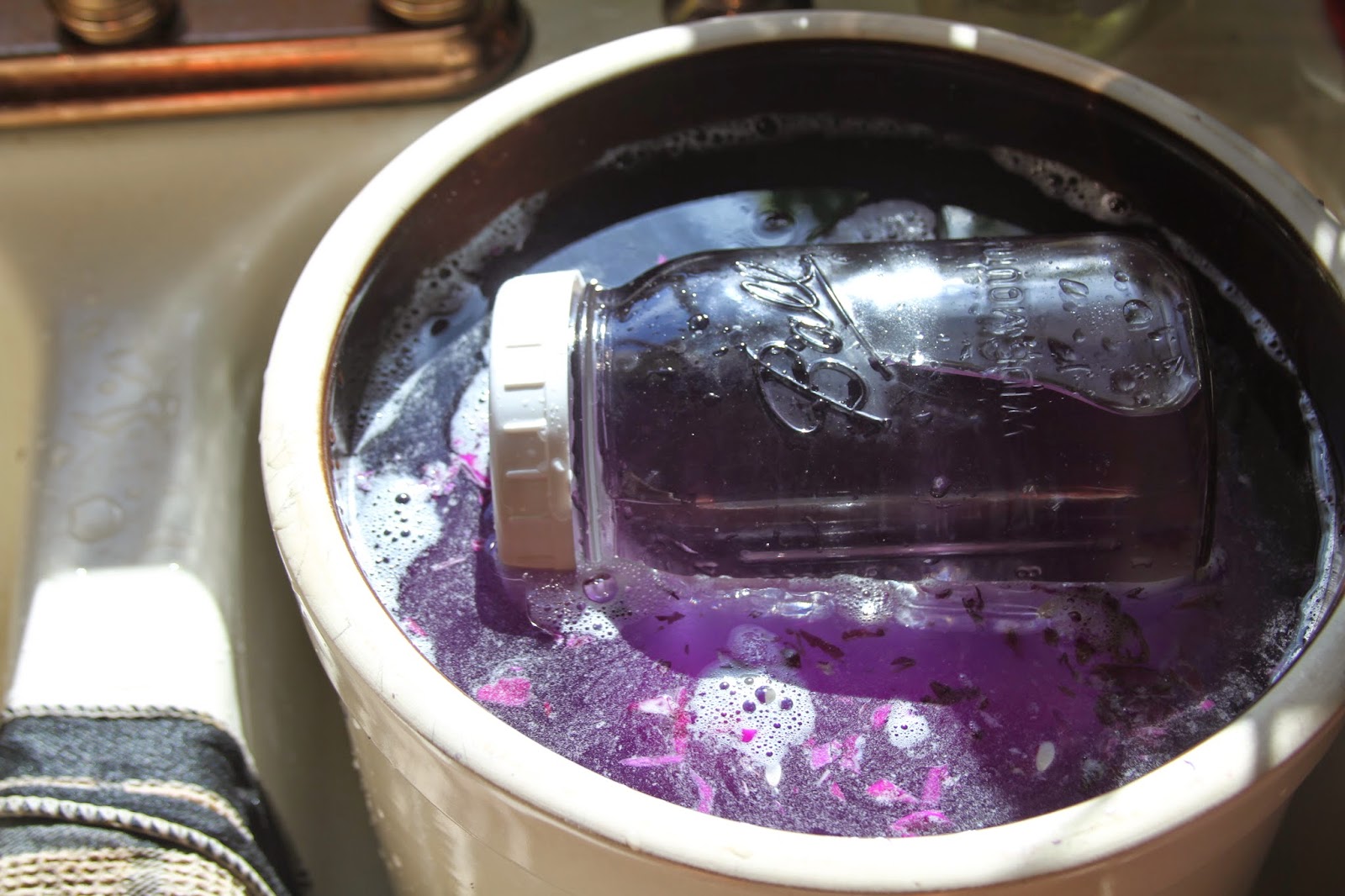
Put a piece of coarsely woven fabric, like cheesecloth (folded many times over), a woven dish towel, linen or whatever else you find lying around. Add a string or large rubber band to tighten the towel and the wait begins!

I will mention that it's best to put your crock someplace that is not frequented by people. The fermentation process can get smelly and often reek of, well, farts. If the smell coming from your crock is gastric, it's fine. Give it about two weeks and you're ready to remove the lid (also more pleasant to do this outside) and put the kraut into jars!
Bon Apetite!
Questions? Feel free to ask more questions in the comment section and I will do my best to answer them!
Tuesday, October 7, 2014
Stocking Up!


Much of this summer was consumed with preparing to move to Idaho and we were not able to put the time into growing food for winter storage. On one hand, it's a bit sad to not have the abundance of food we typically fill our shelves with, but it's also a kind of liberating. I can go to the local farmer's market and purchase exactly what I know I'm capable of preserving and putting up for the winter. So often, I found myself with three dozen pumpkins too many or not enough storage bins for all the parsnips and potatoes. Thinking I would get to preserving or eating them, some would rot or get floppy and I would kick myself for not giving more away upon harvest.
So! with just the right amount of pumpkins and cabbage, I will be able to manage a few crocks worth of sauerkraut and pressure canning (hopefully) a couple dozen quarts of pumpkin.

When we moved to Idaho last month, many neighbors started talking about getting ready for winter. Back in Oregon, I'm not typically thinking about winter until mid-November but apparently up north here, a homesteader should start having some essential winter supplies by mid-October. I'm finally getting to the age where I can pay heed to (some) experienced advice. So wood is really the main agenda right now. Getting enough firewood for a long winter is truly a process. Lucky for us, the sellers of our new cabin left us with at least a cord of wood to start. We'll need about five with just wood heat. We have been going to the forest, cutting, collecting, transporting, and then splitting and stacking. So many steps, but oh so necessary. Going outside in the morning to collect more logs and smelling the start of a new fire in the stove is such a satisfying experience. Wood smoke is definitely one of the best things in life.


Monday, October 6, 2014
Last of the Bare Bottomed Days


I don't know about you, but I love little baby buns! The summer has given Lars some much needed diaper-free time and given me a break from diaper washing every two days. Sadly though, those days are coming to an end shortly. I find a three to four hour window every so often, but the days are becoming significantly more chilly and that means back to diapering…
Honestly, I'm weary of the whole diaper thing. It's time for toilet training soon but I'm not exactly sure where to start. With so many alternative theories and methods out there for this next developmental period it seems daunting to start. I suppose the real challenge lies in making time. October is historically the busiest month of the year. Half a dozen birthdays, canning like crazy, gathering firewood, and the list goes on and on and on. One day at a time, I know, I know. But somedays it feels like the projects are never going to all get done. For now, I'll enjoy my (not so little) baby buns for a few more weeks of sun and warmth.


Sunday, October 5, 2014

Friday, October 3, 2014
Book Review: Letters of Woman Homesteader

Reading this book kind of made me feel like I should not put myself and homesteading in the same sentence. I don't mean to say it lessened my confidence in what I'm doing, but rather gave me a detailed look into how hardcore homesteading was in the early 1900s of Wyoming.
This is a collection of well written letters by Elinore Pruitt Stewart written to a good friend about her adventures in homesteading after accepting employment as housekeeper for a cattleman. Later, she acquires her own land. These are all letters that were genuinely written by Elinore (and her young daughter occasionally), with little to no editing of them.
Her letters focus primarily on relationships, social and familial, and the chaotic predicaments she gets into, young children in tow. From sleeping under her wagon in the snow (and no provisions), to helping birth babies, to redecorating her log cabin, her real life stories give a strong and humorous voice to how women lived in this incredible era of building western America.
It's worth reading for little nuggets of homesteading how-to's- her details are such that she often apologizes to her friend for such length and specification of every moment….This really was a great book to read, I only wish there were more like it out there!
Subscribe to:
Posts (Atom)